Air traffic control communications dissolve into static. The plane has been hijacked by men who may have murdered the pilots or threatened the rest of the passengers with a similar fate. The passengers know that earlier flights have been crashed into buildings and that countless lives have been lost. Faced with this harrowing information, they are not immobilized. They are led by a man who deploys the resources at hand to save the lives of others. He calls his mother, a former flight attendant, not to say a few parting words, but to ask how to take control of the aircraft. He directs other passengers and together they attack the men they have just seen brutally wrest command of the plane. He takes action that we know today saved thousands of .lives. The plane crashes into an uninhabited Pennsylvania field rather than perhaps the nation’s capital.
In those decisive moments on board Flight 93, the passengers become Mark Bingham’s teammates, and Jack Clark, Bingham’s rugby coach at Cal, taught Bingham to protect his teammates.
If you were to spend time around Jack Clark’s players, a very clear image of the man they couldn’t talk enough about would materialize—even if you’d never met him, or heard him speak. Between cringe-worthy accounts of tough love in practice, stories of his facilitation of former players’ success in post-college endeavors, or the vested interest of 70 young students in the life of a man who at once mentors them and keeps his personal life an enigma, you’ll see the same look of veneration repeatedly appear in the eyes of Clark’s players. Over and over, they will talk about a topic they could never discuss in practice, a topic their coach avoids with a firm, colossal hand. They will talk about the larger-than-life figure that is their coach.
A framed Latin insignia welcomes all visitors to the Doc Hudson Fieldhouse: “Spectemur Agendo.”
I meet Jack Clark for the first time as I take a seat across a big, wooden desk from him in the Doc Hudson Fieldhouse.
As I begin to film, I see a hat with the number 12 sitting on a shelf above his desk.
“That’s a Joe Roth hat,” he says. “Know who he was?”
I ask Clark if he played with Roth. He amends my description of their dynamic: “I protected him.”
Joe Roth had been on my dad’s “you need to know who they are” list when I was growing up.
In 1975, Joe Roth transferred to Cal on the heels of an undefeated season and 1974 state title at Grossmont College of El Cajon. With Roth at the helm of the offense, the Golden Bears won a Pac-8 title, and led the nation in total offense. Roth played his last year as the only person on the roster that was aware of his own terminal melanoma. He died shortly after the conclusion of the 1976-1977 season.
“We believe in toughness,” Clark says. “Not the guy that thinks he’s tough, but keep-getting-up-toughness— that kind of mental toughness.”
I ask Clark if he played with Roth. As he affirms, he amends my description of their dynamic.
“I protected him.”
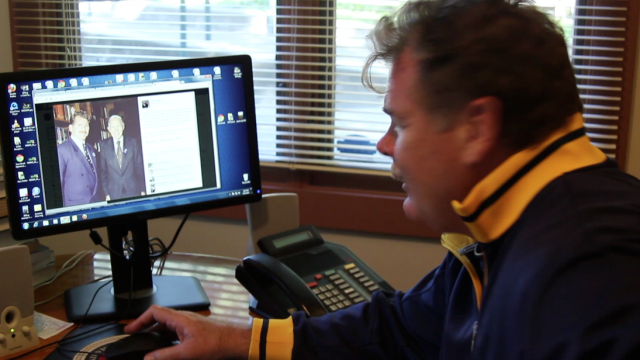
I continue to film in his office, while he fervently glues himself to his computer screen. As I focus my camera on a frame that houses a personally addressed letter from the Chairman of the Joint Chiefs of Staff, I feel certain that whatever is claiming his undivided focus is highly classified. I wouldn’t have been surprised if he was hatching the next Argo, but with rugby… or something… from that very desk.
After I finish filming his various awards, honors, medals, photographs, and office adornments, as well as being subjected to a pop quiz on humidors (Him: How many humidors are in this office? Me: 400,000. Him: A humidor is a case where you store cigars. Try again.), I head for the main room in the field house, but stop in my tracks at the sound of a voice that seems like it is accustomed to being obeyed.
“Want to see something cool?”
He wanted to show me his Argo plot. I hurry back to the desk.
Jack Clark is on Facebook.
As he looks at the screen, his face cracks into a smile, which seems just as much a natural expression for him as the focused stoicism he generally exudes.
In the slightly grainy picture, a younger but similarly grinning Clark stands with his arm around an older man with white hair and glasses. Both are dressed up, in Cal colors. Bookshelves are in the background, the kind whose imperfectly arranged contents betray that they’ve seen more than their fair share of action.
“Know who that is?” A break from the screen to question me.
I had already blown the humidor question, so naturally I cheat and glance quickly at his caption, hoping it will help me out. It’s my lucky day.
Casually: “Glenn Seaborg.”



Hi, this is a comment.
To delete a comment, just log in and view the post's comments. There you will have the option to edit or delete them.